

Today’s post, my 1,000th published article, marks an achievement I am tremendously proud of and excited to share.
Here’s the funny story of how I started writing. My journey into blogging and speaking began 18 years ago when someone told me, “Isaac, great social networking site, but it needs to plug into the blogosphere.” All I heard was “blog,” so I wrote my first post on application logging.

The blog was more technical back then, and the topics I covered and the audiences I wrote for expanded as my career progressed – from my startup CTO days, to the challenges of being a young and early-to-the-game of being a transformational CIO, to now leading my company, StarCIO.
My commitment to guiding digital transformation leaders
My 1,000 articles include over 600 on the StarCIO blog, 175+ on InfoWorld, 50+ on CIO.com, and posts on over 30 other websites. I publish a data visualization so readers can find articles, and my monthly Driving Digital Newsletter has links to all my writing, Driving Digital Standup videos, and upcoming Coffee with Digital Trailblazers.

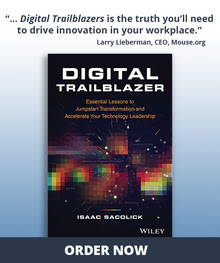
My goal has always been to share my learnings, stories, and advice with lifelong learning Digital Trailblazers – people who lead and aspire to lead digital transformation in their organizations and deliver business impacts. My first book, Driving Digital, guides on the foundational practices that enable digital transformation, including agile planning, DevOps, becoming a data-driven organization, portfolio management, product management, and driving culture change. My second book, Digital Trailblazer, has fifty digital transformation leadership lessons, told through my stories in first-person narrative. You get a seat at the table when I debate business priorities, answer questions to the Board, and contemplate what it means to form the right leadership team.
The writing and speaking I share extends to StarCIO, where we guide organizations in developing the leaders and practices for driving digital transformation as a core competency. Our SMB and enterprise clients using our digital transformation programs have become public fintech unicorns, hospital systems transforming the patient experience, and nonprofits have scaled their impacts by 10x. And our evangelist services have helped digital trailblazing technology companies reach C-level audiences through my unique perspectives and programs.
Three time-tested fundamentals for digital transformation leaders
I confess, but I had a bit of writer’s block thinking about what to cover in this post. I polled several friends for advice on themes and how to celebrate this achievement. I asked myself, “What can I write about on this 1,000th post that may stand the course of time?” Which fundamentals can everyone learn from my experiences, regardless of whether they are CXOs, Digital Trailblazers, young innovators, SaaS founders, and others who seek to develop technology, data, and AI competitive differentiating experiences?
I came up with these three regardless of where I was in my career, what was happening worldwide, and what business pressures were weighing me down.
1. Transformation requires changing mindsets, behaviors, and priorities
Over 18 years of writing, I’ve witnessed and led organizations across all the technological evolutions from web 2.0 to cloud, mobile, social, big data, and now AI. We’ve experienced years of growth, recession, pandemic crisis response, industry transformations, and global disruptions during these times.

The key takeaway I shared in Digital Trailblazer is that people and organizations will always be transforming, and thus, digital transformation must be an organizational core competency. During keynotes, I tell audiences to think back over the last five years, and you’ll recognize that objectives evolved from the 2018 growth years, 2020 pandemic response, 2022 financial environment, and 2023+ generative AI-driven transformation.
Technology evolutions and the opportunities/problems facing organizations change, so these are just the contexts of digital transformation.

The conclusion is that the Digital Trailblazers’ best-laid plans are only achievable to the degree they can influence people.
- Executives must set meaningful, clear, and prioritized objectives.
- Everyone managing products, leading teams, overseeing delivery, or maturing data practices must evolve and support digital transformation practices that deliver business outcomes.
- Individual contributors must collaborate on self-organizing agile teams while following and developing operating standards.
If you set too many priorities, focus on the latest emerging technology capabilities, or build a better version of a legacy product or business process, your organization won’t transform.

Start all transformation objectives by focusing on people. Who are the benefiting external customers, partners, and employees? What opportunities and problems do you aim to address, and what legacy practices do you aim to transform? Why is the objective important to the organization, and why now versus other competing priorities? If you participate in my workshops and digital transformation programs, completing vision statements is the start of thinking about people, values, and objectives as a first principle.
A focus on people must continue through the entire release management practices, including agile planning, delivery, and feedback processing. Some questions to consider include
- How is this release impacting stakeholders, experiences, and workflows?
- When should employees participate in sprint reviews to learn and contribute?
- What data will be captured and used to validate operations and drive priorities?
- How are you speaking to end-users and capturing data to provide feedback?
In my experience, too many organizations underinvest in these practices, which is why I called “prioritizing everything” and “neglecting change management” two of the seven sins of digital transformation.
Today, with the magnifying glass on automation and AI, it’s even more important for Digital Trailblazers to adopt a people and human-centric approach to digital transformation.
2. Digital Trailblazers focus on questioning, lifelong learning, and experimenting
During my early years, I remember advisors saying, “Make sure you stay current with your technology and skills.” While skill development is important, it’s insufficient, especially for Digital Trailblazers.

Lifelong learning requires developing research skills, experimenting to capture feedback, experiencing different challenges, and teaching what you know. Last year, I released a Digital Trailblazer Career Checklist, and this year, I am collaborating with several leaders on the top 50 attributes of Digital Trailblazers.

I’ve written 23 articles focused on how important asking questions is when challenging the status quo and looking to change people’s mindsets. Favorites include
- Three useful questions to unblock scrum teams – “What many agile leaders face nowadays is an agile hodgepodge of what people have experienced and embraced in other organizations and teams.”
- Three expert questions to focus on winning digital transformations – “Look at your company as if it were your first day on the job. What would your first impressions be of how your business is operating?”
- Seven questions to prioritize your DevOps backlog – “The list of practices, tools, and maturity levels is growing, and it’s no longer a trivial matter for devops teams and technology organizations to determine what areas to prioritize easily, what approaches are most viable, and what level of maturity is good enough.”
- Ten questions before starting a Machine Learning POC – “If you are asking to have an ML POC completed with results in two, two-week sprints, then I would suggest pausing and taking a dose of reality pills. Your culture must support experimentation, questioning, pivots, learnings, and failures before embarking on a machine learning proof of concept.”
- Five questions transformational leaders and PMOs should address when driving digital – “[Sadly], in many organizations, the PMO is synonymous with bureaucracy and administration since many focus on tracking projects, managing budgets, defining project management standards, and overseeing risk mitigation.”
I also have seven posts about experimenting, and one favorite is how to focus stakeholders on the benefits of agile planning and experimenting.
In this next era of generative AI transformation, asking questions, prompting, validating answers, and experimenting are even more vital skill sets for Digital Trailblazers.
3. Show frequent gratitude because the transformation journey doesn’t end
This last time-tested fundamental comes from Bob Violino, a prolific technology writer I admire. He messaged me last week about his new online journal focused on positivity and gratitude, and I look forward to reading it.
I can’t think of a more important lesson for Digital Trailblazers. How often do technology teams complete an important milestone and miss celebrating because they are thrown into the next priorities? When an IT Ops team resolves a major incident, do we thank them and provide the mechanisms to address root causes, or do we move on to the next set of issues? When a product manager releases new capabilities early, do we celebrate key learning from customer feedback or throw the team under the bus for their misses?
Bob’s message and post made me think about an article I wrote many years ago on the four strange leadership mementos on my desk and what they mean. It also brought back some sad memories of what brought me to write the five things to do when your career hits rock bottom.
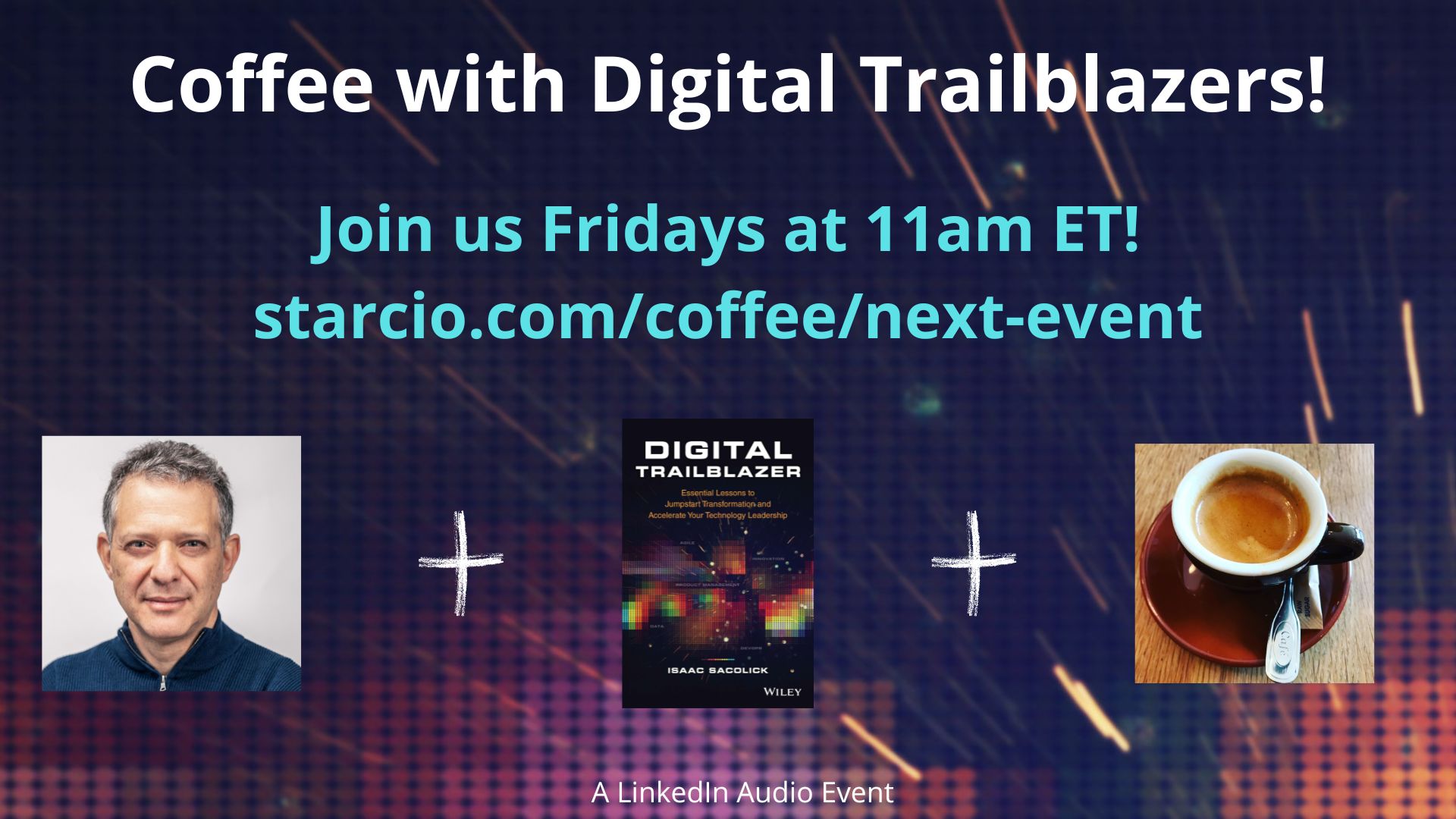
So it’s in this spirit of showing gratitude that I want to thank a large group of people who have been speakers and fans of my latest experiment, the Coffee with Digital Trailblazers. I host the event on Fridays at 11 am ET and select topics for all levels of Digital Trailblazers, technologists, product managers, data specialists, marketers, and others who drive their organization’s digital transformation initiatives. Over 2,000 people have participated in the 55 events I hosted, and I am committed to continuing this program.
Thanks to an amazing group of contributors: Joanne Friedman, Heather May, Jay Cohen, Joseph Puglisi, Martin Davis, Tyler James Johnson, John Patrick Luethe, Michael Voellinger, Ashish Parulekar, Roman Dumiak, Alma Kondili, Emily Ricketts, Paul Desruisseau, Kit Johnson, Sarbjeet Johal, Martha Lewis, Jeff Eissinger, Bradley Foster, Kannaiah Vadlakunta, Marlene Veum, Janette Gleyzer, Liz Martinez, Ritesh Agrawal, Karen Lippman, Domenic Ravita, Jonathan Feldman, Shaun Guthrie, Marc Hayem, Mitch Schussler, Jennifer Speciale, Kristin Farley, Philip McKay, Kiba Polk, Jason James, Jay Ferro, Robert Field, Blaine Mathieu, Lynne Chernow, Gary Berman, Larry Lieberman, Scott Dacko, Helen Knight, Pushkraj Deshpande, Eric Mumford, Jeff Ton, Kristen Lamoreaux, Laura Smilingyte, Brian Turpin, Gary Gray, Bill Murphy, Karthik Natarajan, and many, many other fans! Apologies to the people I accidentally missed.
Another group that I’d like to thank is the past and present editors at CIO.com and InfoWorld, including Doug Dinely, Jason Snyder, Eric Knorr, Galen Gruman, Athen O’Shea, and Kristen Crockett.
Thanks for celebrating with me today on completing this milestone.










Leave a Reply