Category: CHRO, Human Resources
-

Shadow AI: 5 Critical Risks and How to Address Them
Shadow AI can reveal valuable innovation, but unmanaged use creates serious risks. Employees may expose confidential data, grant excessive privileges to AI agents, bypass spending limits, leave undocumented workflows, or trigger changes across dependent systems. Organizations should encourage experimentation through sanctioned tools, clear policies, least-privilege access, monitoring, accountability, knowledge transfer, and disciplined AI cost and…
-
Trusting AI Agents: What CIOs Need To Know
CIOs facing pressure to deliver AI business value will need trusted platforms for agent development, especially for backoffice HCM and ERP data. At Workday Rising 2026, executives announced the Workday Trusted Agent Platform, 17 job-based AI agents, and new strategic Decision Intelligence agents for the CHRO, CFO, and CIO offices.
-
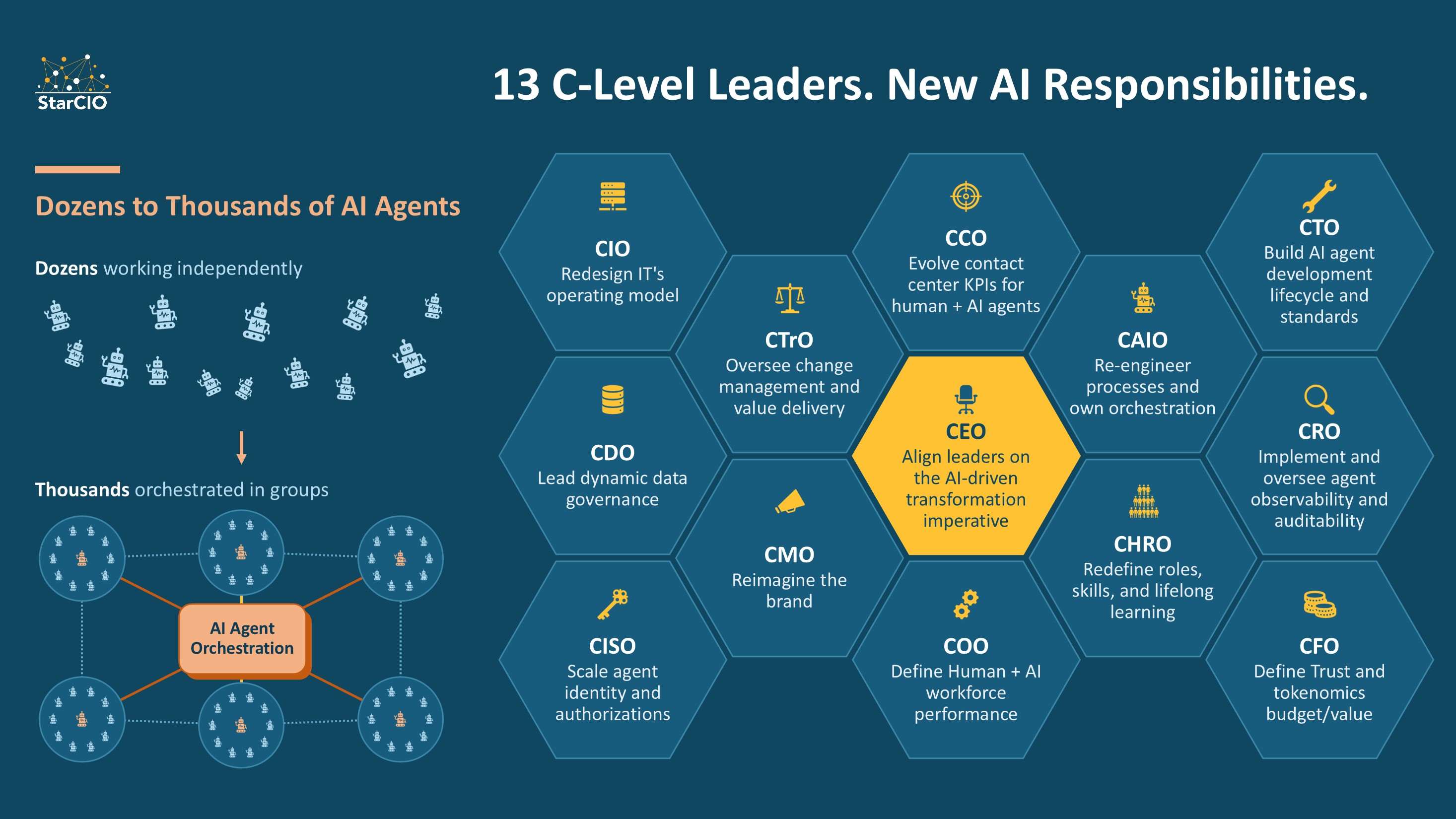
Dozens to Thousands of AI Agents: The 13 C-Level Leaders With New Responsibilities
Exponential increases in deployed AI agents requires new C-level leadership roles around growth, architecture, people/process, and risk management. CEOs have to lead responsibility assignments and setting a transformation imperative. StarCIO proposes responsibilities for CIO, CDO, CISO, CTrO, CMO, CCO, COO, CAIO, CHRO, CTO, CRO, and CFO, and where they need to collaborate.
-
How to Accelerate AI’s Path to Business Value in Industrial SMBs
AI tools can boost individual productivity but require leaders to re-engineer workflows for ongoing business value. By fostering AI literacy among all employees and utilizing platforms, partners, and learning programs, organizations can empower staff to adapt and innovate. Successful AI adoption hinges on collaboration and employee engagement in dynamic workflows.
-

Twenty-Five Years Later: My 9/11 Story
In this reflective account, Isaac Sacolick recounts his experience during the 9/11 attacks, blending personal narrative with professional urgency. He details his journey to a merger meeting, interrupted by news of the World Trade Center collapse. Amidst confusion and panic, thoughts of colleagues and loved ones surface, revealing the day’s profound impact on his life.
-
How Knowledge Management Drives AI’s Context Layer: 5 Industry Examples
Knowledge management is a key process for developing the AI’s context layer. The article explores opportunities and challenges in five industries: healthcare, financial services, construction, manufacturing, and higher ed. Common challenges include change management, executive alignment, data integration, and data governance. Opportunities include faster time-to-decision, improved CX, and enabling agentic AI operations.
-

AI Is Only as Good as Your Talent: Five Ways People Amplify Its Value
As AI transforms the workforce, organizations must adapt talent strategies to leverage human skills that machines cannot replace, such as critical thinking and ethical judgment. Cooperation between talent and AI enhances innovation and drives business value. Companies must prioritize skilled talent nurturing to maximize AI effectiveness, ensuring ongoing collaboration and expertise.
-
5 Essential Questions for CIOs on Planning IT Careers in the AI Era
The rise of AI in IT roles is causing concern among employees about job security and their future IT careers. While CIOs are improving employee skills and career development, a structured career planning approach is lacking. AI is transforming roles, necessitating a focus on new skills and leadership capabilities for future growth.
-

College Graduates are Very Pissed Off About AI
At a University of Arizona commencement, students voiced their frustration with AI’s impact on job prospects, particularly during Eric Schmidt’s address. Many graduates, facing economic challenges and career uncertainties, were unprepared for AI disruptions. Instead of blaming external factors, they should embrace emerging opportunities and continue learning to shape their futures.
-

The Autonomous Enterprise in the AI Era: What CIOs Need to Know
Can AI agents form the basis of the autonomous enterprise? SAP’s vision for the autonomous enterprise features role-based “assistants” to augment employee capabilities. New announcements include Joule Studio 2.0, AI governance capabilities, and AI industry solutions. SAP shared AI Agent Hub, open spec-driven development, and continuous monitoring for effective AI adoptions and development.
-
4 Ways to Boost Entry-Level Talent in the Gen AI Era
The rise of generative AI is leading organizations to reduce entry-level positions, potentially creating a talent shortage. Studies indicate a significant decline in opportunities for early-career workers. Experts suggest redefining roles, fostering AI literacy, implementing apprenticeships, and developing specialized training to maintain a robust talent pipeline in the evolving job landscape.
-
How to Develop AI Literacy in Your Organization? A Useful Leadership Guide
Organizations are focusing on developing AI literacy to enhance understanding and usage of AI agents. Key strategies involve setting pragmatic AI goals, ensuring top-level engagement, implementing responsible data security practices, and fostering critical thinking skills. Leadership must balance AI risks with effective training to create an ethically aware, AI-literate culture that drives transformation.