


There was a passionate dialog this past weekend on #CIOChat about whether IT needs steering meetings. If you review the thread on this chat, you’ll notice that a number of us oppose the idea of a steering meeting.
Some of us have felt the pains of trying to get these meetings to work as intended – and most of us believe the name of the meetings, it’s agenda. and it’s attendees need to change when organizations target digital and business transformation.
Here is one of my responses:
Agreed that culture factors heavily in gov models.I would never call it a steering committee. I “drive” even though the road is paved before me. I don’t “get steered”— Isaac Sacolick (@nyike) December 15, 2018
Jonathan Feldman also chimed in with a multi-tweet thesis that starts with the following bold statement
I have an opinion on this matter, and y’all might not like it. 90s-style “IT Governance” and “Steering Committees” ought to be EXTINCT, along with 300-page RFPs, tech-centrism, and Waterfall project management (thread)— Jonathan Feldman (@_jfeldman) December 16, 2018
Why IT Steering is Out
- Validating projects/initiatives have to be business and IT initiatives, not just IT
- Businesses can not afford IT to have backseat roles; being “steered” implies “IT as a butler” and being a service to the business – not the strategic enabler that innovative digital technology organizations aspire to becoming and delivering.
- Many organizations associate “IT Steering” with infrequent (yearly?) meetings that are misaligned to the agile, feedback-driven practices digital IT organizations are driving.
Strong rant @_jfeldman & I agree w your points. Main issue is that biz leaders want to weigh in on strategy & priorities at a higher level than sprint & release schedule prioritization. That two way feedback is what I call “Driver’s Voice” which I’ve used to recalibrate priorities— Isaac Sacolick (@nyike) December 16, 2018
What is Driver’s Voice

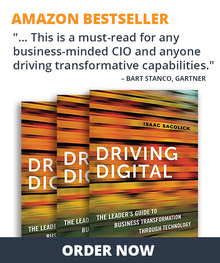
In my book, Driving Digital: The Leader’s Guide to Business Transformation Through Technology, I devote a full chapter to the modern, agile driven portfolio management office (PMO). Organizations love and hate PMOs – love them because they bring communication, reporting, and order to the hundreds of initiatives running in a modern enterprise – hate them because they are associated with bureaucracy.
In the book, I provide some guidance on how to fix this and leverage PMOs to drive innovation while ensuring compliance and technical debt is still addressed. I describe a meeting – and I forget what I call it in the book – that I now rebrand as the Driver’s Voice meeting. You can read about it in detail in the book, but here’s what goes on in a Driver’s Voice meeting.
- It’s an open meeting for leaders, but “Drivers” run the meeting and are given voting rights.
- All running initiatives provide very short, written weekly updates that feed into this meeting. Drivers can ask to have one or more initiatives reviewed at the meeting. Typically, ones that are expressing risk, are near execution milestones, or require a strategic pivot are good candidates.
- New initiatives and initiatives ready for a stage-gate transition are reviewed. Voting is done by the Drivers on these initiatives openly and their votes are aggregated to a score.
- The score is a non-binding input to the CIO (possibly with the CFO and others on the executive committee) on how to prioritize investment dollars and resources.
- Meeting frequency is dependent on culture. I’ve done it as frequent as weekly, but more often this is a monthly meeting.











Leave a Reply