

Are you feeling the impact of technical debt on accelerating DevOps, delivering innovations, and driving digital transformation?
Recent research shows organizations are spending almost as much time addressing technical debt (28%) compared to running operations (38%) and building new capabilities (33%). Ouch.
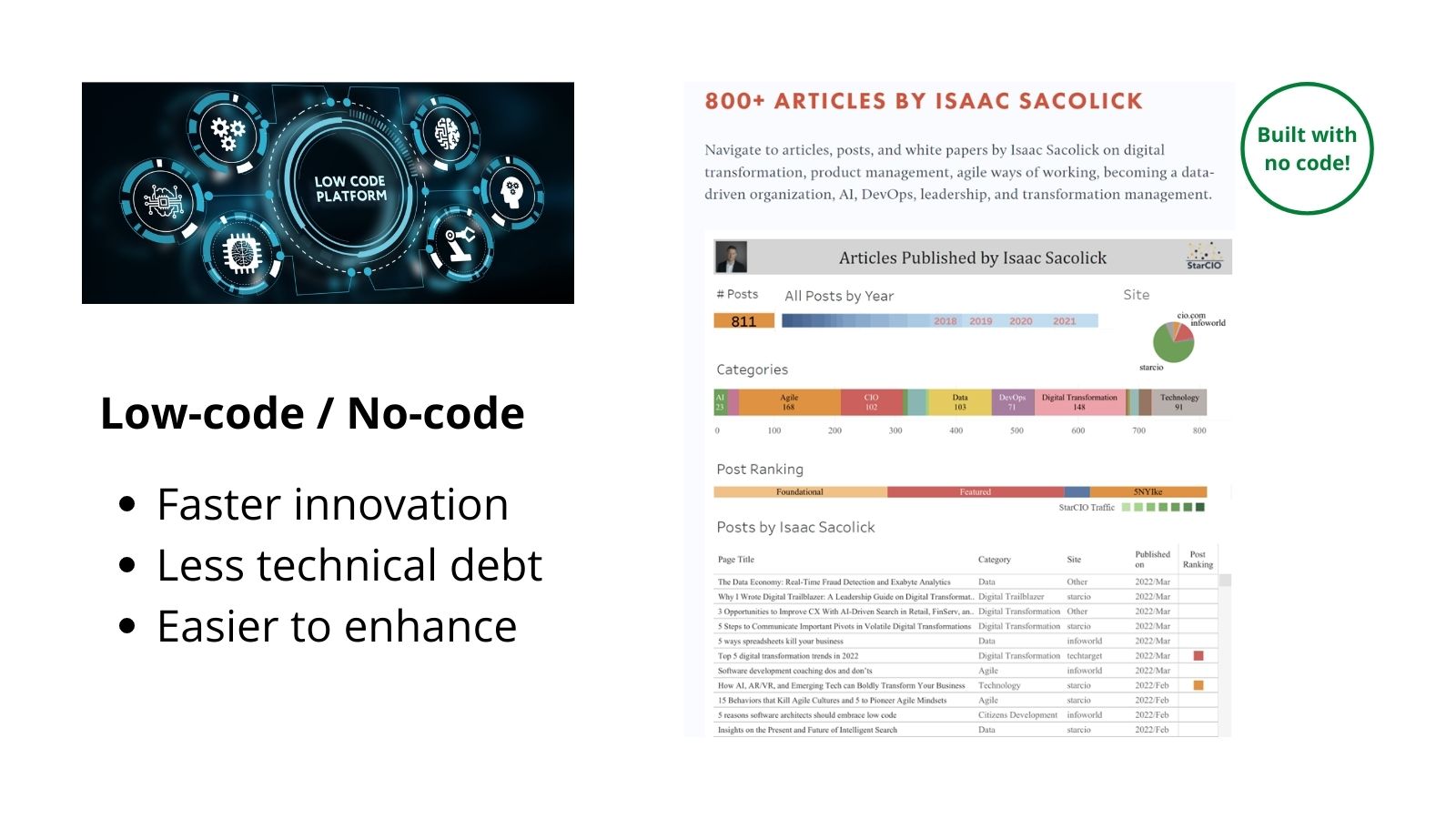
You already know that I am a strong proponent of citizen development, low-code, no-code, and citizen data science. Recent articles include five reasons architects should embrace low-code and why citizen development is core to digital transformation 2.0.
In this post, I connect how low-code / no-code is a strategy to reduce technical debt – both existing debt and the risk of creating new sources of technical debt. I share my insights and insights from other tech leaders.
And scroll to the end to see my latest 5 Minutes with @NYIke video on how I use no-code technologies to capture all my articles, store them, and deliver this dashboard to browse all of them. Watch the full video as I share five recommendations on developing no-code apps, databases, and integrations at the end.
My Insights on How Low-Code Reduces Technical Debt
- Abstractions in low/no-code apps help to build capabilities with less expression and more guard rails. It requires avoiding adding custom code to the low/no-code app and only doing so where absolutely required. So most low/no-code apps have less or no tech debt by design.
- App modernizations from code (w/ tech debt) to low/no-code (less/no-tech debt) drives the reduction. Keep in mind that many legacy apps often have a lot of code for implementing UX, automating integrations, and addressing performance issues that can be out-of-the-box with low/no-code platforms
- Using low/no-code can change the conversation w/ stakeholders. Instead of getting “must-have” requirements that often require custom code, POCs, and using sprint reviews to demo capabilities in low/no-code, help draw out simplified MVPs by asking stakeholders, “will this work?”
- With citizen development, a business user is more likely to implement what works more efficiently. Example – a dashboard built by SMEs rather than writing requirements for dev or data science teams and then iteratively building one that meets the needs. But citizen development requires a governance model, and citizen data science should be paired with a proactive data governance model.
- Test automation is also code and has its own technical debt. Automating testing in a pro-code app often requires unit tests and functional tests that are orchestrated in CI/CD as continuous testing. But as any test engineer will tell you, one small change in the UX can sometimes require a full rebuild of the dependent tests. Low/no-code platforms can help reduce testing, and they are less likely to have dramatic UX changes version to version. This helps reduce the debt associated with maintaining test automations.
Insight from Tech Leaders on Low-Code Opportunities
And many other tech leaders embrace using low-code technologies.
I spoke with Rosaria Silipo, Principal Data Scientist and Head of Evangelism at KNIME, on her perspectives around using low-code tools. She says, “Low code tools accelerate the development of applications. There is still a technical debt in the sense that testing, documentation, optimization, etc., must all be implemented and run at some point. However, the development phase itself is faster, leaving more time for the remaining tasks, bypassing the code learning part, and therefore avoiding some typical coding mistakes.”
Gev Hovsepyan, head of product at Mabl, knows that testing apps – whether built with low-code, no-code, or pro-code also need low-code tools to build and maintain test automations. He says, “As more software development organizations adopt agile and DevOps, manually maintaining a spreadsheet of all testing activities is going to slow time-crunched QA teams down. Modern test automation solutions that provide comprehensive reporting and insights can make it easy to track and manage automated testing at a glance.”
My Demo: A Blogger’s Database and Dashboard
Years ago, I maintained a spreadsheet with links to all my blog posts. But as I contributed more posts, articles, and videos to different websites, it became difficult to maintain. I wanted to search the articles, plus I had the idea of sharing a dashboard with readers to help find all my articles.
So in this video, I share how I use Quickbase, Tableau, Zapier, Talend Stitch, Google Analytics, Squarespace, and AWS RDS to build an end-to-end flow. Trust me, it’s not complicated, but you see the result of several iterations, and the MVP was much simpler.
And please watch till the end of the video to get my five recommendations on developing no-code apps, databases, and integrations.











Leave a Reply